Scientists “make” a new grape the same way nature does—pollen meets flower, seed becomes vine—but with rules, patience, and a ridiculous number of seedlings. The tools are simple: grape flowers, pollen, tweezers, paper bags, and today, a bit of DNA testing. The hard part is doing it hundreds or thousands of times, then waiting years to see which vines are actually worth keeping.
How you physically create a new grape
Step one is setting the goal: better disease resistance, more stable yields, cold hardiness, later (or earlier) ripening, or a specific flavor profile. For hybrids, this usually means pairing a vinifera parent (such as Gewürztraminer) with an American or French-American selection that brings toughness to the table.
Then comes the hands-on part in the vineyard:
Choose the “mother” vine. Breeders select a vine whose flowers will carry the seeds for the cross.
Remove its own pollen. Before the flowers shed pollen, they carefully snip off the anthers (the pollen-producing parts). This “emasculation” keeps the flower from self-pollinating.
Bag the cluster. The treated flower cluster gets covered with a small bag to keep out stray pollen from wind or insects.
Add the chosen pollen. When the timing is right, breeders dust pollen from the “father” vine into the bagged flowers. That’s the controlled cross: Parent A × Parent B—on purpose.
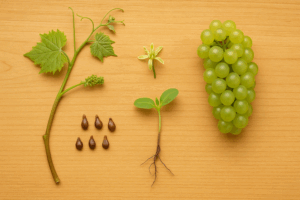
Harvest seeds, not fruit. At the end of the season, they don’t care how the grapes taste yet. They collect the seeds from those pollinated clusters, dry them, germinate them, and grow each seed into its own baby vine.
Each new vine is genetically unique. Most are duds. A few are interesting. An extremely small number of named varieties become available. Before anything is released, those candidates go through years of vineyard trials: disease screening, cold damage, yield checks, and small test fermentations to see if the wine is actually good or just “survivor juice.” Increasingly, breeders also use DNA markers to quickly check whether seedlings carry genes linked to disease resistance or other target traits—but they’re still working with naturally created crosses, not inserting foreign genes.
Traminette: a real-world case study (and why it fits our vineyard)
Traminette is a clean example of this process—and it’s in your glass at Willowcroft. It began when breeder Herb C. Barrett crossed Joannes Seyve 23.416 (a French-American hybrid known for its cold hardiness and disease resistance) with Gewürztraminer (famous for its floral, spicy aromatics) in 1965 at the University of Illinois. That plant material was later sent to Cornell’s New York State Agricultural Experiment Station, where researchers evaluated it for decades before officially releasing Traminette in the 1990s.
The goal: capture Gewürztraminer-style character in a vine that could actually handle real-world pressure—humidity, fungal disease, and cold—in places like New York, the Midwest… and Virginia.
From a science standpoint, every Traminette vine in our vineyard is a vegetative copy (a clone) of that one successful seedling selected from thousands. It only exists because:
someone hand-pollinated those flowers,
someone raised and tracked the seedlings,
someone spent years tasting trial wines and measuring performance,
and only then said, “This one deserves a name.”
So when we pour Traminette and talk about its Gewürztraminer lineage and hybrid strength, we’re really talking about classic plant breeding at work: intentional cross-pollination, natural genetics, long-term selection, and zero GMO shortcuts. For guests who want the broader context—how clones, vinifera, and hybrids all fit together in our vineyard strategy—this piece pairs perfectly with our first “clones & hybrids” blog and with a visit to see those vines doing exactly what they were bred to do.