The spotted lanternfly (SLF) has quickly become one of the most talked-about invasive species in Virginia—and for good reason. First detected in the region just a few years ago, it has steadily expanded across Northern Virginia and the Shenandoah Valley. What started as a concern is now a reality that vineyards, farmers, and communities are actively managing together.
While the insect itself is striking in appearance, its impact is anything but harmless. Spotted lanternflies feed on the sap of plants, weakening them over time. They are particularly drawn to grapevines, which makes them a serious concern for Virginia wineries. But vineyards are not their only target. SLF also affects hardwood trees, ornamentals, and agricultural crops, putting pressure on both the environment and local economies.
Why It Matters for Wine
Grapevines are especially vulnerable because SLF feeds in large numbers. When populations build up, the insects can stress the vines by depleting essential nutrients. Over time, this can impact vine health, reduce fruit quality, and affect yields. For wineries, that translates into both agricultural and economic challenges.
In addition to feeding damage, SLF produces a sticky substance called honeydew, which can lead to the growth of sooty mold. This black coating can cover leaves and fruit, interfering with photosynthesis and creating additional stress on the plant.
For a region like Northern Virginia, where wine is both an agricultural product and a local experience, the impact extends beyond the vineyard. Healthy vines are essential not only for production, but for the long-term sustainability of the industry and the enjoyment of guests who visit and support it.
A Broader Community Impact
Spotted lanternfly is not just a vineyard issue—it is a community issue. Infestations can affect backyard trees, gardens, parks, and wooded areas. Tree of heaven, one of SLF’s preferred hosts, is common in many areas, helping the insect spread more quickly.
As populations grow, so does the nuisance factor. Large groups of SLF can gather on trees, structures, and outdoor spaces, leaving behind honeydew that attracts other insects and creates a sticky, sometimes unpleasant environment.
That means managing SLF is not just about protecting crops. It is about preserving the quality of outdoor spaces, supporting local agriculture, and protecting the broader ecosystem.
What the Public Can Do
One of the most important aspects of managing spotted lanternfly is awareness. Unlike some agricultural challenges, this is one where the public can play a meaningful role.
Here are a few simple ways to help:
- Look for and remove egg masses during late fall through early spring. These appear as mud-like patches on trees, vines, outdoor furniture, and even vehicles.
- Report sightings in areas where SLF is newly detected to help track its spread.
- Avoid transporting materials like firewood, outdoor equipment, or landscaping items from infested areas to new locations.
- Remove tree of heaven where appropriate, as it serves as a key host for SLF populations.
These small actions, when taken collectively, can make a real difference in slowing the spread.
Community Action in Motion
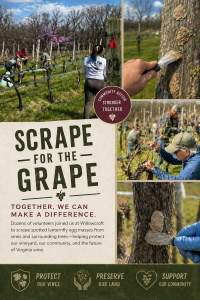
That spirit of collective effort was on full display at Willowcroft this past month during the Scrape for the Grape events. Dozens of volunteers came out to help remove spotted lanternfly egg masses from vines and surrounding trees.
It was simple work, but meaningful. Each egg mass removed represents hundreds of potential insects that will never hatch. Just as important, the events brought awareness to the issue and connected people directly to the role they can play in protecting local vineyards and landscapes.
Events like Scrape for the Grape are not a complete solution, but they are an important part of the bigger picture. They help reduce local populations, raise awareness, and build a sense of shared responsibility.
Looking Ahead
Spotted lanternfly is likely to remain a part of the landscape in Virginia for the foreseeable future. But that does not mean the outcome is fixed.
Through a combination of research, vineyard management, and community involvement, there is a path forward. Awareness leads to action. Action leads to impact.
At Willowcroft, we are grateful for the support of our community and encouraged by the willingness of so many to step in and help. Protecting the vineyard is not something we do alone—it is something we do together.
And sometimes, it starts with something as simple as scraping an egg mass from a vine.